




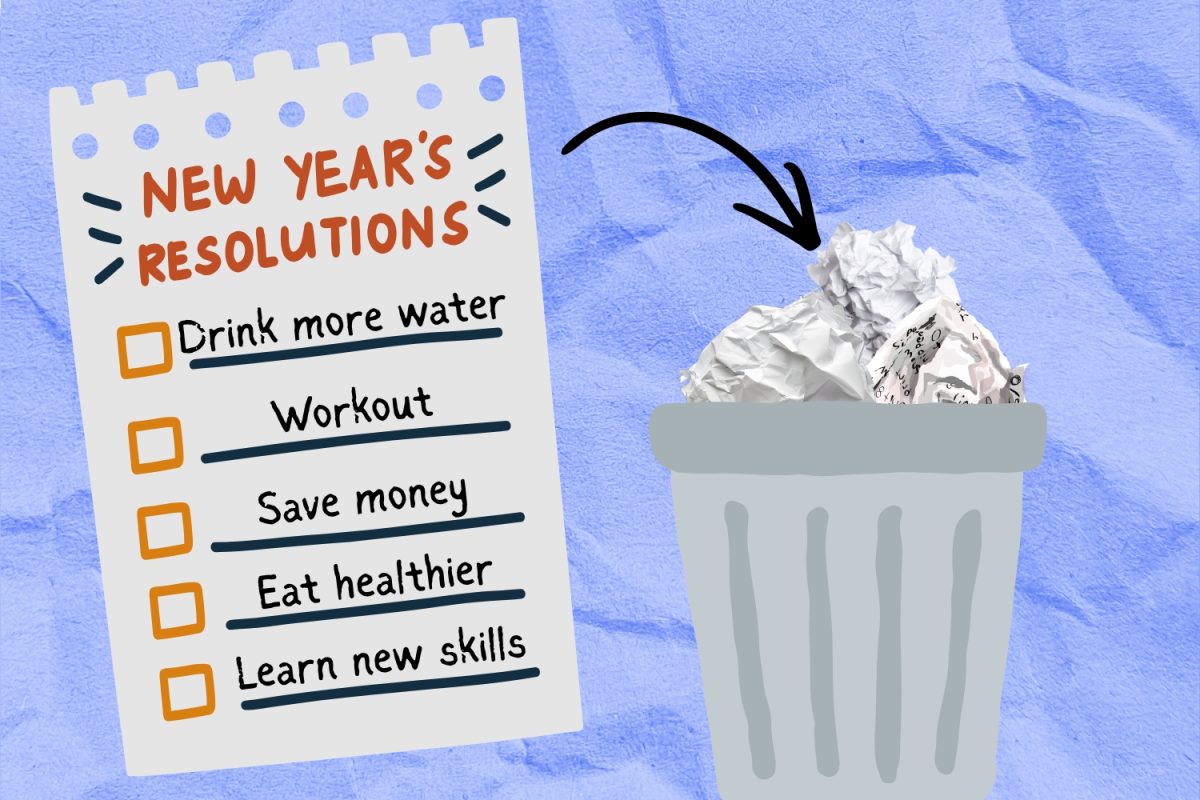
Every Jan. 1, when the world comes together to celebrate the new year, we excitedly share our newest ambitions. Inspiring goals like eating healthier, exercising more, quitting smoking, or finally getting organized. The start of a new year offers a mental refresh, and it is the perfect time to work on self-improvement goals, but this never seems to last.
For some, New Year’s resolutions do work. “New Year’s resolutions give us a chance to reflect, to dream, and to start again,” said Dr. Glenn Miller, a behavioral health expert. Even when they fail, they remind us that personal growth is ongoing and not confined to a calendar date.
However, these records seem to last only a little while. According to a study summarized by Verwell Mind, about 80% of New Year’s resolutions fail by the second month of the year.
“I’ve seen my friends say that they’re gonna do stuff for the New Year’s and then that never really works out,” senior Maxwell Nilles said.
Miller says the problem is not our ambition; it is the way we approach change.
According to GlennMiller.com, “New Year’s resolutions often set us up to fail because they rely on a binary mindset: you either succeed completely or fail completely. There’s no room for gradual progress.”
Nilles also points out that the goal itself may be at fault.
“They don’t really set themselves [a] standard [for] their goals, ” Nilles said. “They kind of say something they don’t really mean, or they don’t really care enough to try to change.”
Common pitfalls in setting New Year’s resolutions, like setting vague goals, underestimating the ease of commitment, and relying solely on willpower rather than creating lasting habits, make it substantially harder to keep them.
“It’s easy to lose motivation quickly, especially when people get tired or overwhelmed,” junior Lali Majumdar said.
For instance, instead of saying, “I’ll exercise three times a week,” adopting a broader identity goal like “I am someone who prioritizes my health” allows for more flexibility. This reduces the pressure of the all-or-nothing mindset that dooms many resolutions.
Yet despite these challenges, people continue to make resolutions. The act of making a goal itself serves an important purpose. It signals self-reflection and sparks motivation.
“One of my New Year’s resolutions is to be more positive,” said Majumdar. “It’s made me feel much better about myself, and every day… I have more motivation.”
While creating resolutions is exciting, keeping them is daunting, which is why it’s important to remember why we make them in the first place: to grow.
“The goal isn’t perfection, but progress,” said Miller.






▸ Rude or obscene language (i.e. swear words, sexual jokes, violent threats, etc.)
▸ Hate speech (i.e. racism, sexism, homophobia, etc.)
▸ Insults towards a specific student or a teacher
▸ Content that is irrelevant to the article or does not add to the discussion
▸ Submitting comments under somebody else's name
Refer to the student handbook for further specifics on what is considered appropriate.
The Social Media Editor will read and evaluate all comments. Should there be any issues with a particular comment, the Social Media Editor will consult the newspaper adviser and Online Editor-in-Chief.