




*For this work, the term white supremacy refers to the structure of domination that privileges whiteness and the traits historically tied to whiteness. This permeates economics, housing laws, culture, and education. Through this lens, we can see that white supremacy not only manifests in specific policies like redlining or residential schools, but also the foundational logic that allowed them to come about, and the systems that continue to uphold that logic.
History is often approached as a neutral record of the past, an objective science used to learn about the processes that brought about the world as we see it today. It’s because of this view, though, that the techniques used to teach history are rarely understood as ideological choices, even when they actively minimize historical violence. Through omission of details, selective framing, and specific word choice, a tale of pillage and conquest can turn into a patriotic story of hope. In the context of US history courses, it has become evident that the biases formed through hundreds of years of racial hierarchy continue to show up in our curricula, leading to consequences that range from misleading to harmful.
One example is that of Christopher Columbus, whose story is so central to American mythology that his name is almost always mentioned in discourse on the genesis of the American identity. But what’s rarely explored are the reasons why he’s long been seen as a national hero, and who benefits from it. The truth is, mainstream narratives surrounding the birth of the United States are often deeply rooted in romanticization and dehumanization, causing the ‘objective truth’ to get muddied. However, this phenomenon extends beyond Columbus or even the Founding Fathers. From its inception to the present, American history has been steeped in narratives that erase marginalized voices, whitewash violence, and reinforce dominant power structures. Colonization is analyzed in the past tense to separate our national identity from the violence on which it was built. Imperialism is treated as a finished process, as to disconnect modern politics from historical injustices. All of these trends are the product of a nation born out of white supremacy, and our reluctance to confront that fact is why our children continue to learn half-baked and sanitized narratives about the cause and extent of oppression, both past and present. Though the extent of this pedagogical trend is broad, it does not exist solely in the abstract; it manifests here at Metea, too. In the following sections, I will explore several instances of course content from the IPSD 204 Summer US History curriculum that uphold white supremacy.
For many students, taking a US history course is the first time they have been exposed to concepts like imperialism in an academic setting. But for every student who is unfamiliar with such systems of oppression, there is another who was not born with the privilege of ignorance. These students, like me, don’t get to talk about colonization in the abstract because it still permeates into our lives through the structures of domination it produced and the generational scars it caused.
This lived reality was one of the many reasons I opted to take US history over the summer this year. But, despite its short length, the course still proved itself a manifestation of the patterns of erasure and sanitation I described. While there were numerous instances of harmful framing, these few examples might help highlight the ways we’re taught to excuse systematic violence.
Very early on in the course, during the unit about the colonization of North America, it became apparent that the systemic violence and cultural genocide imposed on indigenous Americans was seen as a byproduct, an unfortunate consequence of more important processes such as fighting for equal representation in British Parliament.
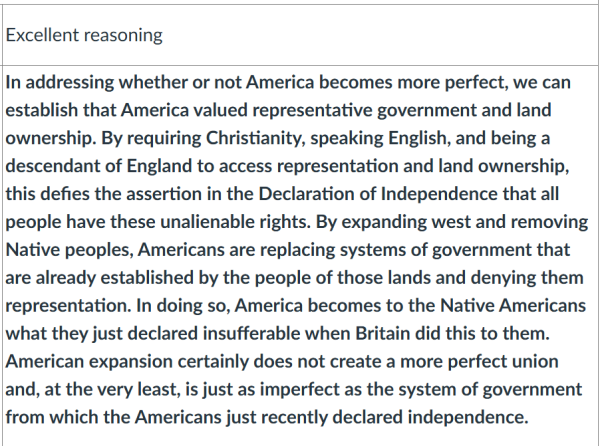
While the passage may seem like it does a good job of calling out the colonists, a closer look reveals that it still fails to accurately represent the situation. By using a “you become what you hate” analogy, the passage actually trivializes the scale of the violence committed by the colonists. It tries to draw parallels between the religious persecution the colonists experienced in Britain and the assimilationist policies they enacted inside the colonies. Yet in doing so, it erases the extent of the violence they caused, calling out only their hypocrisy in the context of religious and political freedom. This kind of framing was not an isolated event; it’s built into the framework of analysis found throughout. In fact, the course regularly asks students to analyse whether or not the colonists had compromised their values during colonization and expansion, as this was the primary question in the first summative. The problem lies in the fact that this question is so focused on whether or not the colonists had violated their philosophical principles that it shifts the conversation away from the materially evident ethnic cleansing campaign towards an ethical debate about enlightenment philosophy. The colonists’ biggest offence was not hypocrisy; it was genocide. Through this passage, the course starts by giving students a message: “Americans are the main characters; everything else is secondary.” This not only sets a foundation of erasure, but also encourages students to follow this ‘excellent’ example of historical reasoning.
Later on, in the section leading up to US imperialism, another easily-missed set of word choices would continue creating an environment that excused systems of domination as eventualities.
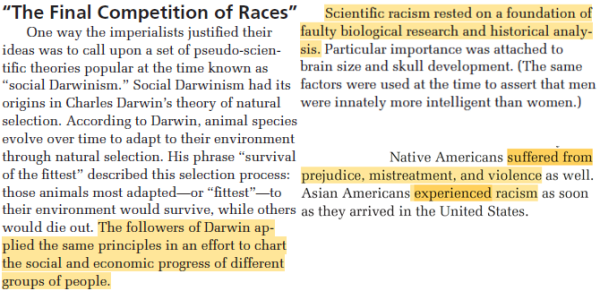
While the excerpt attempts to connect scientific racism to imperial violence, it fails fundamentally. Scientific racism wasn’t simply a misguided way of thinking; it was a tool specifically intended to moralize the violence of empire. It labels social Darwinists, ‘followers of Darwin,’ and asserts that scientific racism was merely a result of faulty research. In doing so, it promotes the idea that such tools of oppression were natural, if flawed, extensions of real evolutionary biology. The text would explain that “While the explanation of racial differences through scientific ‘discovery’ might have been new in the late nineteenth century, the presence of racism in American society was not.”, yet fails to explain that scientific racism was a product of preexisting hierarchies, not a set of mistakes which ended up favoring the white supremacists by chance.
Furthermore, the text introduces another form of whitewashing: passive phrasing. Native Americans were said to have ‘suffered from’ prejudice, as if it was just an illness that could be endured and not an intentional system of violent erasure through killings, land theft, and assimilation. The colonists did not simply ‘mistreat’ the Native peoples; they tried to entirely remove them, and attempted to do so through systemic violence.
A consistent theme during this course was the treatment of violent processes as purely historical. By creating a layer of separation between us and the topics discussed, it becomes increasingly difficult to approach them with any sort of urgency.
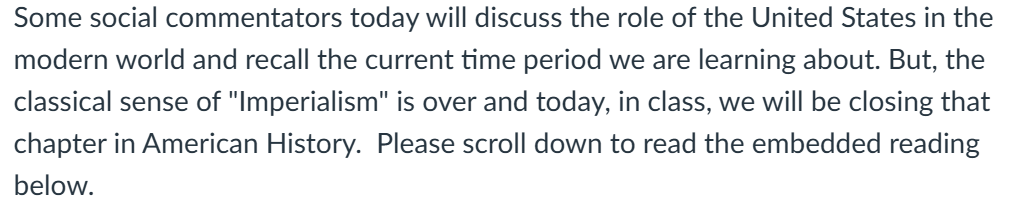
One example of this came during the section on American imperialism. Before it’s even defined in the context of the United States, the course posits that even though Imperialism is a big deal, it is also as inevitable as growing up, and as benign as a birthday party.
The intro to the section reads:
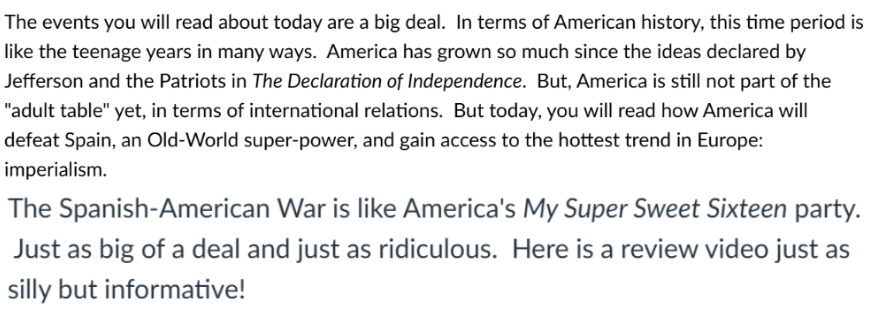
This type of language is not just passive; it is actively harmful. The Spanish-American War was not a party, not for any of the thousands who would be killed as a direct result of its consequences, and not for the generations of Filipinos, Cubans, Chammaros, or Puerto Ricans who would have to endure the legacy of colonization. We are telling our students that this part of our history can be disregarded as juvenile and harmless, and by continuing to position these events as stepping stones to some more mature or modern America, we are not just erasing the violence of colonization but actively excusing it.
But the trivialization did not stop at vague analogy, because as the material delved deeper into the process of imperialism, it continued to sacrifice responsible pedagogy for the sake of neutrality.

The Philippine-American War, framed as an ‘Epilogue’ to the Spanish-American War, was a war of resistance to colonization. The conflict was not between two equal powers, but between one of the most advanced militaries on earth and an already fatigued group of militias. The asymmetry of the conflict was evident not only in military capability but also in the scale of casualties. In trying to frame both sides as equally violent, it creates the message that even though violent tactics were used, it was less of an atrocity and more of a conflict.
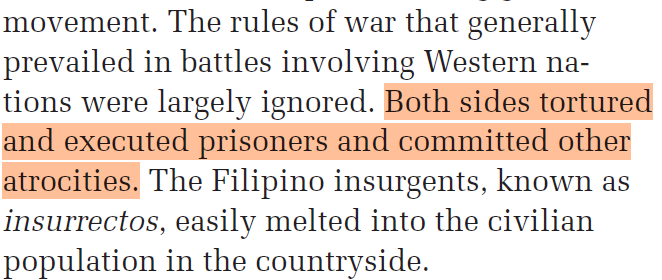
Similarly, the text uses passive language to describe Filipino casualties but active language for the deaths of soldiers, framing civilian deaths as collateral damage rather than a result of war crimes such as starvation campaigns.
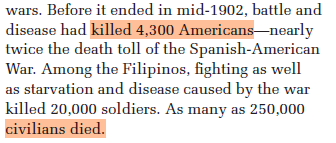
Finally, as the unit came to a close, the course posits that imperialism ended when the Philippines won its independence, allowing the reader to promptly categorize the frameworks of thought and policy that led to such violence as purely historical, removing any imperative to fight against them.
As we’ve seen, there are many different rhetorical choices that curricula make, which can lead to dehumanization, erasure, and trivialization. While each of the above instances is individually harmful, their abundance points to something larger: there is a fundamental flaw in how history is taught in America. Paulo Freire, a Brazilian educator and the author of Pedagogy of the Oppressed, writes that: “There is no historical reality which is not human. There is no history without humankind, and no history for human beings; there is only the history of humanity, made by people and in turn making them. It is when the majority are denied their right to participate in history as Subjects that they become dominated and alienated.” Freire points out that education as it exists in the West today is not just problematic, but a tool of colonization. From his perspective, examples such as the ones presented above are more than just pedagogical missteps, but rather the intended outcomes of a system made to defuse dissent, uphold the violent status quo, and maintain a national identity on a land obtained through conquest and dispossession. Among other decolonial theorists, Freire argues that education ought to be liberatory. History, in his view, should be taught in a way that contextualizes harm responsibly, giving students the tools to recognize oppressive structures and the space to imagine alternatives. Once classrooms stop sacrificing the voices of the oppressed for the American myth, our students will finally be empowered to participate in liberation struggles and build a more just future, one where curricula engage authentically with uncomfortable truths, confront historical violence honestly, and center marginalized voices.

The Angry American • Jan 29, 2026 at 9:27 pm
This is a very uneducated take on us history circular, and it shows how much people like to cherry pick around parts of history and even current events. I beg for people like the author to travel the world and educate themselves on history. particularly the thousands of years before europeans even stepped foot on the americas.
Kid A • Dec 19, 2025 at 10:37 am
This is a really intriguing and well constructed article! I’m glad that someone has spoke out about this, it’s a very important subject matter, and something that needs to be covered more today. I learned a lot from this. Great Job!
Enlightened_Patriot • Dec 18, 2025 at 6:40 pm
There is no clear perspective from which one could attempt to try and explain history that does not end up biased. In addition, some of the assumptions here are historically sloppy: Columbus was Jewish, and does not conform to what we view as “white” today, and slavery was not just a consequence of white supremacy, as, commonly, African tribes would enslave one another for the procurement of European goods, to name a few. It also raises the question to what extent should we include modern American history? And how should we teach modern history? Do we teach America’s alliance with Israel as a tale of what happens when lobbyist money invades political spaces, to the point where genocide is bankrolled? Do we teach 9/11 not as a black-and-white tale of terrorism, but deception and greed of our government to increase involvement in the Middle East on baseless claims of WMDs? Do we teach the sinking of the USS Liberty as a story of terrorism, or an honest mistake? Who decides where the line is drawn? These claims need to be more substantiated for them to be truly worth more than a mildly intriguing commentary on “white supremacy.”