




Most college requirements have one that may be more tricky than others; “Language other than English: 2 years required, 4 years recommended” (University of Illinois). The requirement of a foreign language has a history deeply rooted in those who settled the lands. It starts in the late 1800s, when the Bureau of Education first started enforcing laws nationwide (people just didn’t follow them before this). These laws required schools to teach in English. This made it necessary for schools to change all main curricula to English, moving others to extra electives. In 1906, the government introduced the Naturalization Act. According to Karin P. Hartmier, “It determined that every immigrant seeking American citizenship was required to speak English to the satisfaction of a naturalization examiner.”
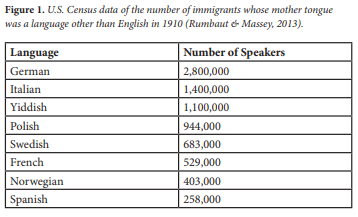
Around the 1960s, multilingualism drastically decreased. Most states enforced English, which became the standard even in foreign households. Throughout WWII, there were fluctuations in the popularity of language education. The most important developments were the decision to allow schools to teach foreign languages, which were highly unpopular, and the shutting down of Japanese Language Learning schools after the attacks on Pearl Harbor. The next major development was not made until the Cold War, a grueling standoff between the US and the Soviet Union. Educated Russians fled to the US despite heavy scrutiny and the possibility of death. However, the US saw an influx of people from its enemy as a problem. These Russians were arrested and deported, which led to people having to deny and conceal their heritage and culture, which included not speaking Russian. Language education continued to be a problem within the states through the years, with highlights of Chinese education in California being a controversial topic.
The next large controversy or change for language education was the attack of 9/11. After this attack on America, immigration rates dropped from around 477 thousand to about 310 thousand. Accompanying this, there were rising concerns about children learning languages that may be a threat to national security. This stagnated the push for multilingual education and further delayed its eventual integration nationwide. In 2017, only 1 in 5 students was learning another language in school.
Language learning is very beneficial in everyday life. With Spanish being the unofficial second language of the United States, language learning is still on the rise. People are being encouraged to learn new things and unlock new paths they would not have had before.
Language learning is mandatory, but I believe that not everything should revolve around it. Many areas of study revolve around things other than language, but the fact is that valuable time in high school should be spent studying for your dream, not college requirements. With the limited amount of time and elective spaces that people have, some do not get to try all of the things that interest them because of classes they have to take. High school is meant to open opportunities for all, but having to take a language for two years just to go to college for something completely unrelated to your field of study makes the wide list of classes at Metea seem like a game of maximizing your time.





Ryan Doucette • Apr 30, 2026 at 7:33 am
Another common Maks w