




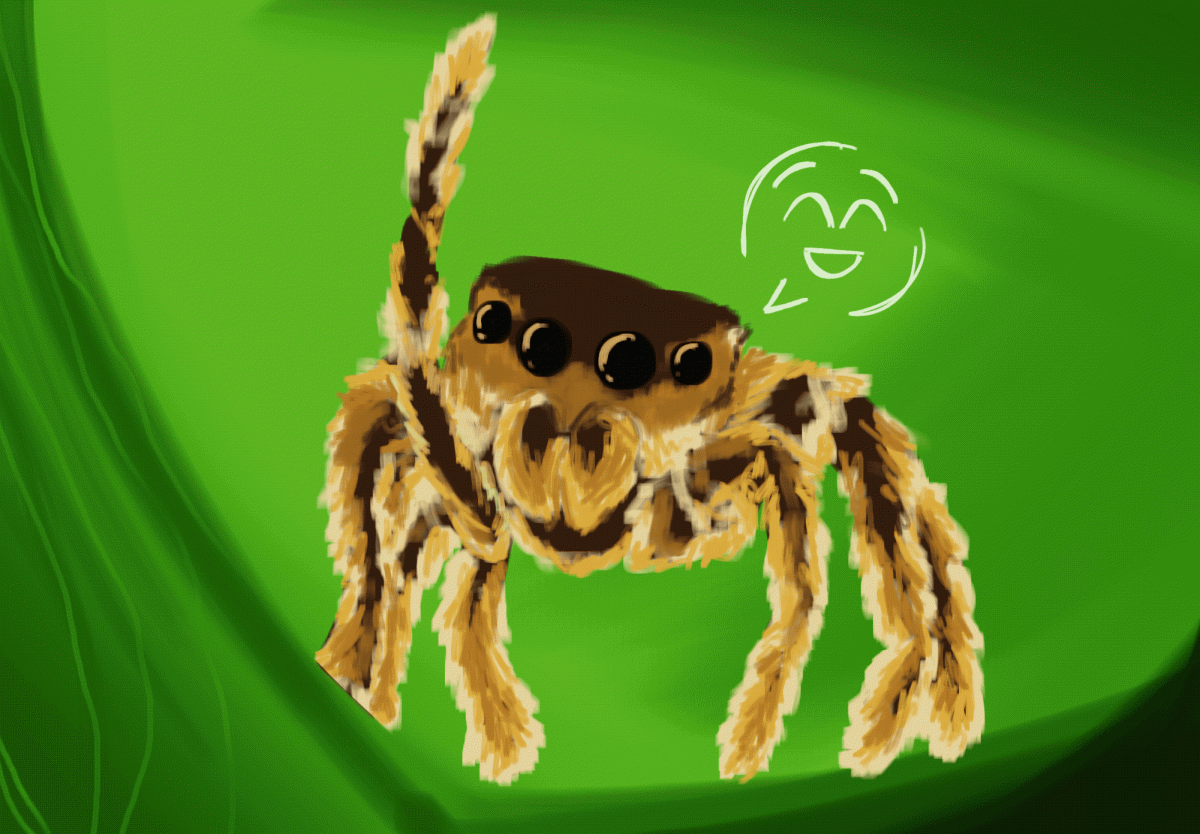
There is a lot more in them than we think, whole ecosystems we cannot even fathom. We may not even see them, but they are there. One of these animals is spiders.
As spiders crawl around your home, up your walls, under your beds, in your basements, they remain innocent creatures.
When you hold your slipper, they do not know that the rubbery surface will be the last thing they see. They do not understand why you decided to kill them.
These creatures, as scary or disgusting as people may think they are, mean no harm to anyone. They lost their environments, their safe space, so they had to appropriate a new one. Yes, while that may not be ideal, killing them is not the solution.
A basic myth to start with is that every person eats an average of 8 spiders per year in their sleep. A complete and total lie.
Rob Crawford, the leading spider expert in Washington State University and the curator of arachnids Burke Museum of Natural History and Culture, feels very strongly about diminishing the bad reputation associated with spiders.
“Once or twice a year, someone tells me they once recovered a spider leg in their mouth,” Crawford said.
It is very unlikely for spiders to go to you during these times; in fact, it is more likely that spiders go away from you during your sleep.
Spiders have simple eyes, meaning that they usually do not see a lot. Additionally, according to the Australian Museum in Darlinghurst, spiders move based on touch, vibration, and taste stimuli. As we sleep, we cause a lot of vibrations that would draw spiders away.
“Vibrations are a big slice of spiders’ sensory universe,” Crawford said. “A sleeping person is not something a spider would willingly approach.”
When you’re sleeping, your vibrations come from breathing, snoring, heart beating, and more. This overload of stimuli is terrifying to spiders, and would be considered a danger to them. Spiders interpret this as something to flee from rather than something to approach.
It is not impossible for a spider to crawl on your face, it is highly unlikely. If it were to happen, it would be an entirely random event.
Under normal circumstances, if a spider was crawling on your face, you would most likely awaken. You would not sleep through it and as they crawl into your mouth.
Another common misconception about spiders is that they are dangerously venomous.
A constant exposure from the media to dangerous spiders, real and fictional, leads us to believe that all of them carry harmful venom. In reality, it is far from the truth.
Dr. Brittany Campbell, entomologist for the National Pest Management Association, agrees that these negative views over spiders are enlarged by popular media and word of mouth.
“There are just a handful of species that can really hurt people,” Campbell said. “But because of this fear that has really been perpetuated in general, the general public fears spiders more than is probably necessary.”
Almost all spiders are venomous, however, their venom does not affect humans. They carry a venom that is effective against their prey, which are smaller insects. This venom works similarly to an insecticide.
However, there are still exceptions to this rule, and they are called “medically significant spiders.”
According to Crawford through the Burke Museum, of around 50,000 known spider species, only 25 can cause some sort of illness to humans, to a greater or lesser extent. Those 25 individuals are one-twentieth of 1 percent. Which is not many.
If bitten by a spider, one will experience redness, little pain, and swelling which should pass in a matter of a few days. However, if those develop sweating, swelling of nearby lymph nodes, or other signs that have gone beyond the bite site occur, seek medical assistance immediately.
According to Rutgers University in New Jersey, for better treatment, it is crucial that you take the spider who bit you to the treatment facility. That way, an expert can promptly identify the individual and help direct the proper treatment required.
Out of all spider species in North America, you are likely to encounter 10 in your home, and out of those 10, there are usually 2 in your home.
“I mean we’re talking two species [of spiders] of probably hundreds of species that could be found in and around your house,” Campbell said.
According to MyWildBackyard, there are around nine types of common spiders. These are the cellar spider, yellow sack spider, hobo spiders, wolf spider, jumping spider, spitting spider, southern house spider, house spider, black widows, and brown recluses.
These last two tend to be the most dangerous, since they both carry a neurotoxin that affects humans, making them medically significant. The best way to avoid an encounter is by checking dark and reclused environments in your home.
They are likely to be found in dark cabinets, cardboard boxes, and inside boots. Although they will not act unless provoked, prevention is the best way to avoid any bites.
If you happen to spot them in your home, call experts. They are the ones who will be capable of dealing with them properly.
Meanwhile, spiders, like the cellar spider, originally evolved for cave environments, are now much more common in human settlements since they lost their environment and found our homes to be a very fitting replacement.
To many of us, that is the issue.
Even though most spiders carry venom, all of them carry that venom for a singular purpose: hunting or defense against their natural enemies. A cellar spider, for instance, uses its venom to take down many other arthropods and bigger spiders, like black widows.
While we like to think homes are insulated and isolated spaces, it is not the truth. Human homes, like everything else in nature, are a big ecosystem with many different species interacting.
According to Ehrlich Pest Control, there are several wall dwelling arthropods and mammals including spiders, wasps, bees, termites, carpenter ants, lady beetles, and stink bugs, who call your house their home.
I am not denying that these homely companions are not a bother and that they don’t cause terrible damage to homes, because they do. However, spiders are not one of those; in fact, they eat most of those bothersome insects.
They are on the top of the indoor food web and are ravenous predators; they will eat all those other insects, working as a natural insecticide for your home.
Spiders are generalist predators, meaning they not only eat a variety of prey, but they also regulate a variety of food chains in the main food web that is in a home’s ecosystem.
If you were to remove the generalist predator from your home’s ecosystem, their prey’s population count would rise. There would be no predators to restrict their growth, resulting in an exponential increase in population of all those insects.
One of the most important prey of a spider concerning humans are mosquitoes. They are very drawn towards eating flies and mosquitoes, which carry many diseases.
Even though we now know their benefits, you should never bring spiders into your home for the purpose of pest control. They are still wild animals and only very specific spider species naturally gravitate towards homes.
Additionally, if you notice a venomous spider in your home, you must resist the urge to kill it. These spiders, as their name implies, are dangerous, and you should avoid interacting with them. The best choice you can make is to call a trusted pest control company who will be equipped to deal with the little creature.








Patricia Stumbaugh • May 12, 2026 at 1:48 pm
peak writing as always luisa