




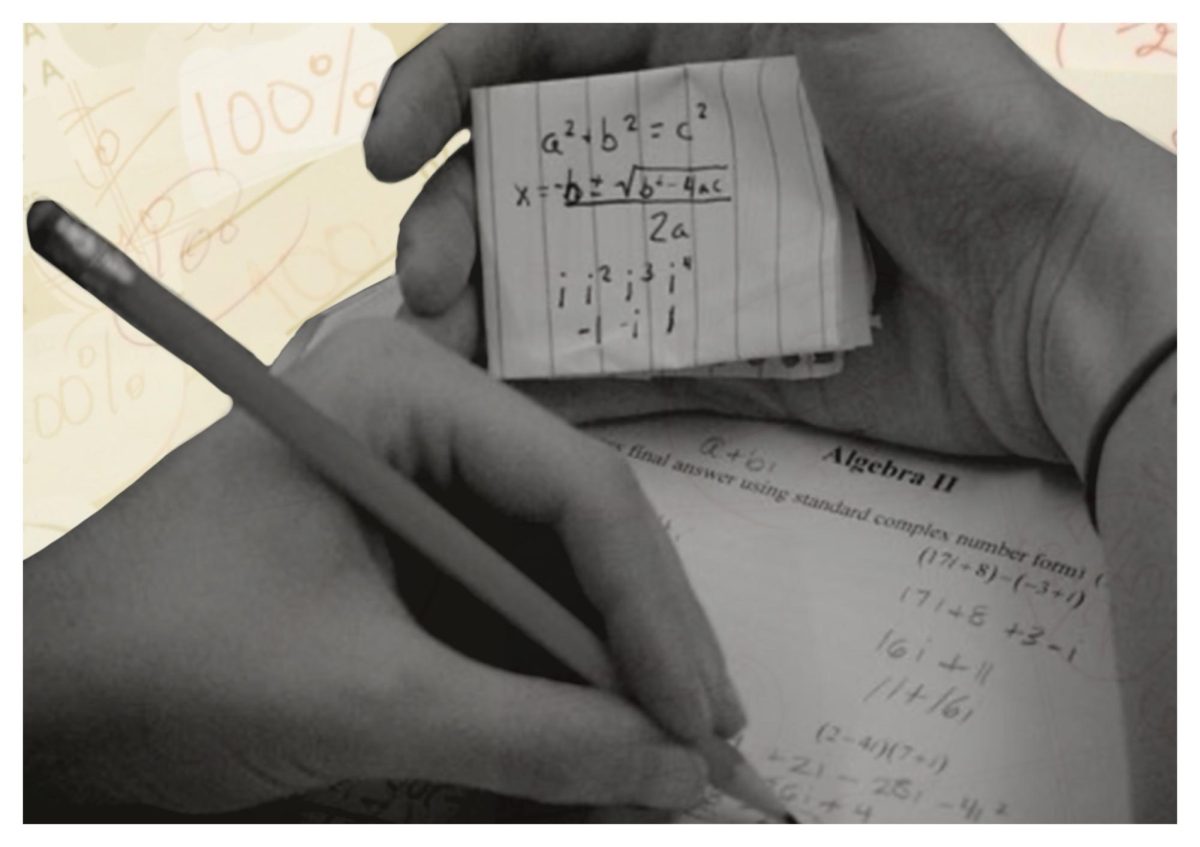
Switching tabs during a quiz to look up the answer to a question is an act of cheating that has crossed every student’s mind at least once; don’t lie to yourself. But having this idea to cheat, even if it’s a small act, is not always linked to laziness or unmotivation, like a lot of teachers tend to think.
Now, cheating is definitely not excusable, but it is a recurring issue. Cheating comes in many different ways. There are small acts of cheating, like copying a homework answer from your friend or just looking over your shoulder to see someone else’s paper during a test. Or there are more serious acts of cheating, such as using AI to write a whole essay for you. Now, some are more serious than others, but they are all common.
In 2020, the International Center for Academic Integrity surveyed 70,000 high school students throughout the United States. 64% of students admitted to cheating on a test. 58% admitted to plagiarism. 95% said they participated in some form of cheating, whether on a test or some form of plagiarism.
So if more than half of high school students have cheated in one way or another, there has to be more depth to the reasoning why, right? It definitely is true that some students do just cheat because they’re lazy or don’t want to work hard. But this is not every student’s reasoning.
“School brings pressure and expectations that cause stress and lead students to cheat or take shortcuts,” senior Jonathan Cruz said.
The universal grading system of either letters or numbers dates back to 1897 to a small women’s college, Mount Holyoke. Of course, there have been adaptations and improvements of this system, but the same concern has always been prevalent.
According to the Human Restoration Project, educational reformer and early adapter of standardization, Horace Mann, expressed concern that students would be too concerned with class rank and chase extrinsic motivation even in 1846. This is definitely occurring today in 2026.
“There’s a lot of pressure to just get a good grade rather than actually demonstrating learning,” senior Ian Imbusi said. “And when you actually have to apply the skill in real life, you have no idea what you’re doing.”
Students feel the need to cheat because they value the approval of their parents and teachers more than the value of actually attaining the information. Getting good grades in school is your ticket to getting into a good college. So being able to cheat, not get caught, and get good grades because of it is seen as an easy shortcut to still be successful and meet everyone’s expectations for you.
Now, doing so is definitely choosing not to have academic integrity, and students should choose not to cheat, or else their future degree is going to be hollow. By not taking a shortcut, you help your future self out. When you cheat, you don’t actually learn the material or attain any knowledge. So, how are you gonna be successful in college or your future career if you didn’t actually learn any of the skills you should have?
If you are having trouble learning the material, there are other resources besides cheating or using ChatGPT.
“Asking friends for help, tutoring, or even taking a lower grade is better than the consequences that can come with cheating,” Cruz said.
Cheating definitely should and will come with consequences. But the commonality of plagiarism and cheating in high school should be an eye-opener for administrators. Our school system and grading system do not have the best interests of students in mind, and they need to be adjusted. Instead of increasing the consequences of cheating, decrease the stakes of the test or letter grades.








Anna • Jan 13, 2026 at 8:36 am
It’s like when you take a test that’s worth a lot of points, and your grade will go up 0.3% if you get 100%, but it’ll drop to below 50% if you get a low score. Many people would rather take the risk of cheating than take the fall.
Michael • Jan 12, 2026 at 8:38 pm
Ian Imbusi spitting facts